- Data analytics
7-Eleven’s $550 million delivery surge: how c-stores are reshaping the QSR landscape
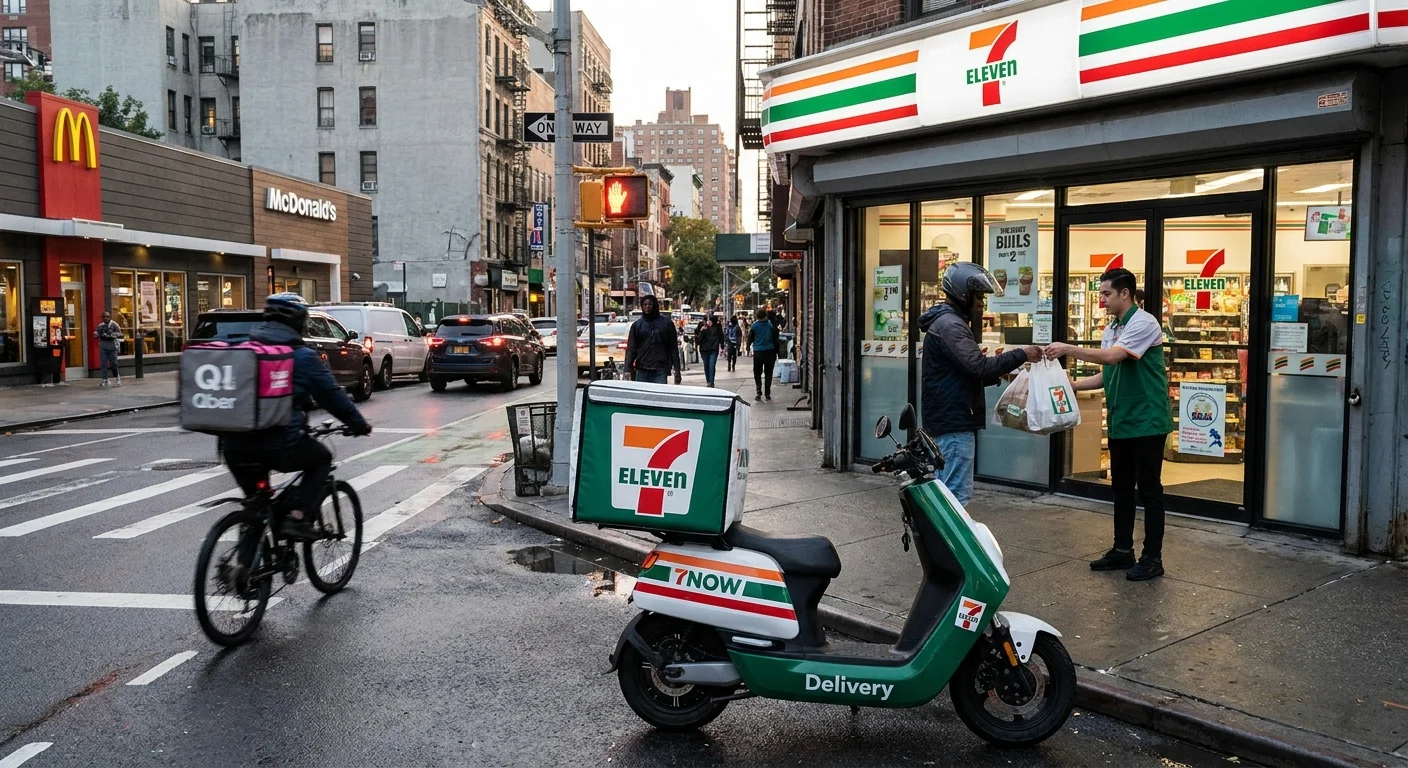
7-Eleven's delivery sales hit $550M in H1 2026. Learn how convenience stores are using delivery and hot food to challenge traditional QSR chains.
7-Eleven’s delivery arm, 7Now, has reported $550 million in gross sales for the first half of 2026, representing a 15.6% increase compared to last year. This momentum highlights a significant shift as convenience stores successfully transition from selling snacks to providing full-service hot meals delivered to the doorstep.
While traditional retail sales remain flat, 7-Eleven is finding its growth engine in the digital space. The 9.9% same-store sales growth for 7Now stands in sharp contrast to the 0.3% dip in fresh food sales at physical locations. This suggests that the customer is not necessarily buying less food, they are simply changing where and how they receive it. By leveraging its network of over 7,500 delivery-enabled stores, 7-Eleven is effectively turning its entire footprint into a distributed network of dark kitchens and micro-fulfillment centers.
The strategic shift toward proprietary Quick Service Restaurant (QSR) concepts inside stores, such as improved boneless wings and new hot sandwiches, shows that 7-Eleven is no longer just a stop for fuel. They are now a direct competitor to major fast-food brands. For executives in the food delivery and restaurant sectors, this represents a new front in the battle for market share. Convenience stores have a logistical advantage, they are often located closer to residential areas than traditional restaurant hubs, which can lead to lower delivery fees and faster arrival times.
Analyzing this shift requires more than just looking at high-level earnings reports. The complexity of 7-Eleven's expansion involves thousands of locations with varying menus and localized promotions. Without granular data intelligence, it is difficult to see which specific regions are seeing the highest penetration of these new food programs. Traditional market tracking often misses the nuance of how a convenience store's delivery menu evolves to mirror a fast-food chain's offerings. Data intelligence helps bridge this gap by monitoring these changes in real-time across the entire delivery ecosystem.
Strategic response to c-store expansion
As 7-Eleven aims for $1.1 billion in annual delivery sales, traditional restaurant chains and delivery platforms must understand where their market share is most at risk. The lines between retail and foodservice are blurring, and the winner will be the one who best understands the local competitive density. To stay ahead of this trend, leaders can gain a competitive edge by benchmarking QSR penetration across different territories. This allows for a precise comparison of how convenience stores are performing against traditional food brands in the same delivery zones.
To learn more about how your organization can use data to track these market shifts and optimize your delivery strategy, please visit our team at DoubleData Contact.
Source: https://www.cstoredive.com/news/3-big-numbers-7now-delivers-gains-for-7-eleven/833128/
